


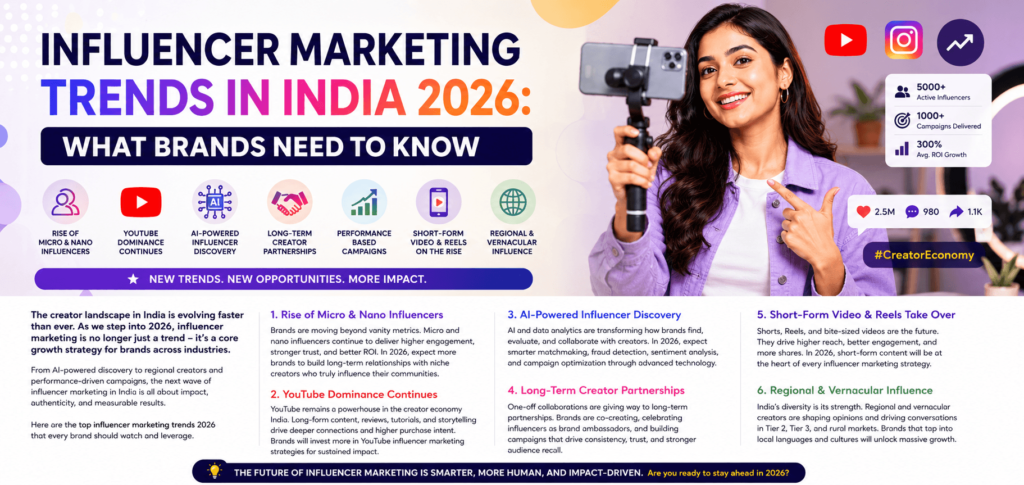
Influencer marketing in India is moving from a reach-focused advertising tactic to a more strategic, measurable, and creator-led marketing channel. In 2026, brands are looking beyond follower counts and one-time sponsored posts. They are increasingly focusing on authentic creators, long-term partnerships, regional audiences, AI-powered discovery, measurable conversions, and creator-led commerce.
India’s influencer marketing industry is estimated at around ₹3,500 crore in annual spend in 2026, according to Kofluence’s latest research. Its report also highlights that 62.1% of surveyed brands favor long-term creator partnerships, while 59% of creators use AI tools regularly or sometimes in their workflows.
For marketers planning their influencer marketing strategy, understanding these changes is essential. Here are the key influencer marketing trends 2026 that brands should watch.
1. Micro and Nano Influencers Are Becoming More Important
One of the biggest influencer marketing trends 2026 is the growing importance of micro and nano influencers.
Instead of working exclusively with celebrities or creators with millions of followers, brands are increasingly partnering with smaller creators who have highly focused communities. These creators can offer strong audience relevance, trust, and engagement within specific niches.
For example, a fitness brand may achieve better results by working with several fitness micro-influencers rather than one celebrity with a broad audience.
For influencer marketing India, this means brands can build campaigns around multiple niche communities while potentially controlling costs and increasing audience relevance.
2. Long-Term Creator Partnerships Will Replace One-Off Campaigns
Brands are moving toward long-term relationships with creators rather than treating influencers as temporary advertising placements.
Kofluence reports that 62.1% of surveyed brands believe long-term creator relationships deliver better ROI than one-off campaigns.
Long-term partnerships allow creators to become familiar with a brand’s products, messaging, and values. Over time, audiences may also see the partnership as more credible than a single sponsored post.
Brands can work with creators as ambassadors, recurring collaborators, product educators, or ongoing content partners.
3. AI-Powered Influencer Discovery Is Growing
Artificial intelligence is becoming an important part of the influencer marketing workflow.
In 2026, agencies and brands can use AI and data analytics to identify creators, evaluate audiences, detect suspicious engagement, analyze content, and improve campaign planning.
Kofluence reports that 59% of surveyed creators use AI regularly or sometimes, while 25.5% use AI almost daily for activities such as ideation and captioning.
However, brands should not allow automation to replace human judgment. Recent reporting shows that creators and audiences remain sensitive to AI-generated content and inaccurate AI labeling, making transparency and authenticity increasingly important.
The best approach is to use AI for efficiency while keeping creative decisions and creator relationships human-led.
4. Regional and Vernacular Creators Are Expanding
India’s creator economy is not limited to major metropolitan cities. Tier-2 and Tier-3 cities are producing an increasing number of influential creators who communicate with audiences in regional languages.
This is a major opportunity for brands targeting India’s diverse consumer base.
Regional creators can help brands develop campaigns in Hindi, Tamil, Telugu, Bengali, Marathi, Kannada, Malayalam, Punjabi, and other languages. Their understanding of local culture can also make branded content feel more natural.
Recent reporting on India’s creator economy specifically highlights the growth of creators from Tier-2 and Tier-3 cities.
For brands expanding beyond metros, regional creator partnerships should become an important part of their influencer marketing strategy.
5. Performance-Based Influencer Marketing Is Increasing
Influencer campaigns are increasingly being evaluated using business outcomes rather than vanity metrics.
Previously, brands often focused on impressions, followers, likes, and views. In 2026, marketers are paying more attention to:
- Click-through rates
- Website traffic
- Leads
- Sales
- App installs
- Coupon-code usage
- Affiliate revenue
- Cost per acquisition
- Return on investment
This shift is making influencer marketing more accountable.
Kofluence reports that 13.3% of surveyed brands now directly link influencer marketing to formal revenue targets.
This means agencies and creators need to understand not just content performance but also how campaigns contribute to the wider marketing funnel.
6. Creator-Led Commerce Is Growing
Influencers are increasingly becoming a bridge between content and commerce.
Instead of simply recommending a product, creators can help audiences discover, evaluate, and purchase products through affiliate links, social commerce features, discount codes, product integrations, and creator-owned businesses.
This is changing the role of the influencer from media personality to business partner.
For brands, creator-led commerce can provide a more direct connection between content exposure and purchase behavior.
7. YouTube and Long-Form Content Remain Valuable
Short-form videos are highly popular, but long-form creator content continues to play an important role in building trust.
YouTube creators can explain complex products, conduct detailed reviews, demonstrate products, compare services, and tell deeper brand stories.
This makes YouTube particularly useful for categories such as technology, education, finance, automobiles, beauty, travel, and consumer products.
Brands should therefore avoid choosing platforms only because a format is trending. The right platform depends on the audience, product, campaign objective, and customer journey.
8. Short-Form Video Will Continue to Drive Discovery
Reels, Shorts, and other short-form formats remain powerful tools for reaching new audiences.
Short videos can help brands generate awareness quickly, test creative concepts, and introduce products to audiences that may not yet know the brand.
A strong 2026 strategy should therefore combine short-form content for discovery with longer content, landing pages, creator reviews, or commerce experiences for deeper consideration.
The objective should not simply be to create viral videos. Brands should build content journeys that move users from awareness to consideration and conversion.
9. Authenticity Will Become a Competitive Advantage
As audiences encounter more sponsored content and AI-assisted media, authenticity is becoming more valuable.
Consumers can quickly recognize content that feels overly scripted or disconnected from a creator’s normal style. Brands should give creators enough creative freedom to communicate products in their own voice while maintaining essential brand guidelines.
Current creator-economy reporting suggests that audiences are increasingly looking for meaningful interactions and genuine community relationships rather than simple reach.
The future of influencer marketing will therefore depend on finding the balance between brand control and creator authenticity.
10. Influencer Campaigns Will Become More Integrated
Influencer marketing is increasingly being connected with paid media, social advertising, affiliate marketing, user-generated content, search, and broader digital campaigns.
Kofluence reports that 76.6% of surveyed brands have run partnership ads with influencers, with 23.3% doing so regularly across multiple campaigns.
This creates an opportunity for brands to amplify successful creator content through paid distribution instead of relying only on organic reach.
11. Data and Audience Quality Will Matter More Than Follower Count
A creator’s follower count is no longer enough to determine campaign value.
Brands should evaluate:
- Audience demographics
- Audience location
- Engagement quality
- Average views
- Content consistency
- Audience interests
- Brand safety
- Previous collaborations
- Sentiment
- Conversion potential
A creator with 50,000 highly relevant followers may be more valuable for a niche campaign than a creator with one million followers who has little connection with the product category.
12. The Creator Economy Is Becoming More Professional
The creator economy India ecosystem is becoming increasingly structured. Creators are operating more like businesses, while brands are introducing formal contracts, legal reviews, performance requirements, content rights, and campaign measurement.
Kofluence reports that 39.3% of surveyed brands route influencer contracts through legal review, showing the increasing formalization of creator partnerships.
This professionalization benefits both brands and creators by creating clearer expectations around deliverables, payment, usage rights, disclosures, and responsibilities.
How Brands Should Adapt Their Influencer Marketing Strategy in 2026
To take advantage of these trends, brands should rethink their approach to influencer campaigns.
Start by defining the business objective. Decide whether the campaign is designed for awareness, engagement, leads, sales, or customer retention.
Next, identify creators based on audience fit rather than follower count. Use creator data and technology for discovery, but validate creators manually before starting a partnership.
Develop content guidelines without over-controlling the creator. Authentic creator storytelling generally works better than content that looks like a traditional advertisement.
Finally, measure the campaign using business-relevant KPIs and use the results to improve future campaigns.
Conclusion
The biggest influencer marketing trends 2026 point toward a more mature industry. Micro and nano creators, long-term partnerships, AI-powered discovery, regional creators, creator commerce, performance measurement, short-form video, and authenticity are reshaping how brands approach influencer marketing.
For businesses operating in influencer marketing India, the opportunity is significant. But success will depend less on simply finding popular creators and more on building strategic partnerships that connect the right creator, audience, content, platform, and business objective.
In 2026, influencer marketing is no longer just about influence. It is about trust, relevance, measurable impact, and long-term relationships.
FAQs
1. What are the biggest influencer marketing trends in India in 2026?
The key trends include micro and nano influencers, AI-powered creator discovery, long-term partnerships, regional creators, short-form video, creator-led commerce, and performance-based campaigns.
2. Why are micro-influencers becoming popular in India?
Micro-influencers often have highly engaged and niche audiences. Brands can use them to reach specific customer segments with authentic content and potentially achieve better engagement and ROI.
3. How is AI changing influencer marketing in 2026?
AI is helping brands discover relevant creators, analyze audiences, identify campaign opportunities, detect suspicious engagement, generate content ideas, and improve campaign optimization.
4. Why should brands focus on regional influencers?
Regional and vernacular creators can help brands connect with audiences in Tier-2 and Tier-3 cities through local languages, culture, and relatable content, making them valuable for expanding reach across India.
5. How can brands measure influencer marketing ROI?
Brands can measure ROI using metrics such as engagement, reach, website traffic, clicks, leads, sales, coupon-code usage, affiliate revenue, cost per acquisition, and return on ad spend.